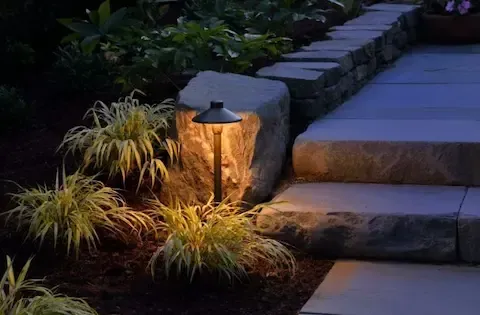
How Many Lumens Should Suffolk VA Pathway Lights Have
Pathway lights in Suffolk, VA should produce between 100 and 200 lumens per fixture. That range provides enough brightness to define walkway edges and prevent tripping hazards without creating harsh glare that disrupts your landscape's nighttime appearance. For most residential paths in Suffolk, 100 to 150 lumens is the ideal starting point. Wider walkways or areas with dense plantings may benefit from fixtures toward the 200-lumen end. Spacing fixtures 6 to 8 feet apart at that brightness level gives consistent, overlapping pools of light along the full path length.
What Is the Right Lumen Range for Pathway Lights?
The 100 to 200 lumen range is the standard recommendation for residential pathway lighting. Below 100 lumens, fixtures tend to feel decorative rather than functional — they create ambiance but don't reliably illuminate the walking surface. Above 200 lumens, a path light starts to behave more like an area light, which can create uncomfortable glare at eye level and wash out the surrounding landscaping. For a well-designed Suffolk pathway, staying between 100 and 150 lumens per fixture and spacing them evenly gives you safe footing and a clean aesthetic without over-lighting the yard.
Does Suffolk's Climate Affect How Bright Pathway Lights Should Be?
Suffolk's humid subtropical climate creates specific considerations for outdoor lighting. Coastal Virginia summers bring dense vegetation growth that can partially block path light output over the season. If your plantings are mature or low-hanging, choosing fixtures toward the higher end of the 150 to 200 lumen range helps compensate for foliage interference. Suffolk also experiences heavy rainfall and occasional coastal fog, which can scatter light and reduce effective brightness. Waterproof fixture ratings of IP65 or higher are standard here, and choosing fixtures with clear rather than frosted lenses helps maintain lumen output in wet conditions.
How Does Spacing Interact With Lumen Output?
Lumen output and fixture spacing work together. If you space fixtures 10 feet apart at 100 lumens each, you'll have dark gaps between pools of light. If you tighten spacing to 5 feet using 200-lumen fixtures, you risk a bright, corridor-like effect that loses the natural look most Suffolk homeowners want. The most balanced approach is to place fixtures 6 to 8 feet apart using fixtures in the 100 to 150 lumen range. This creates overlapping light pools that cover the path continuously without turning it into a runway. For curved or irregular paths, slightly closer spacing around bends ensures corners stay well-lit. Our our Suffolk lighting guide covers broader layout principles that work alongside lumen selection.
What Fixture Type and Beam Angle Should You Choose?
Lumen output alone doesn't determine how well a path light performs — beam angle matters too. A narrow-beam fixture at 150 lumens sends most of its light straight down in a tight cone, creating a bright spot but leaving the edges of the path dim. A wide-beam fixture at the same 150 lumens spreads light more evenly across the walking surface. For standard residential walkways in Suffolk, a beam angle between 60 and 120 degrees delivers the most practical coverage. Bollard-style fixtures with a 360-degree spread work well for wider paths or landing areas. Directional stake lights with tighter beams suit narrower garden paths where you want precise placement.
Should You Use LED Fixtures for Suffolk Pathway Lighting?
Yes. LED path lights are the clear standard for Suffolk VA installations for several reasons. They operate efficiently in the heat and humidity of coastal Virginia summers without the color shift or early burnout associated with halogen bulbs. A 100 to 150 lumen LED fixture typically draws only 1 to 3 watts, making it easy to power multiple fixtures on a single low-voltage transformer. LEDs also maintain consistent lumen output over their lifespan rather than gradually dimming the way older bulb types do. For color temperature, a range of 2700K to 3000K produces a warm white light that complements brick paths, ornamental grasses, and the natural tones common in Suffolk landscaping.
How Many Path Lights Do You Need for a Typical Suffolk Walkway?
For a standard 40-foot front walkway, you would typically need 5 to 7 fixtures spaced at 6 to 8 feet apart. A longer path leading from a driveway to a rear entrance might require 10 or more fixtures. The goal is uninterrupted coverage with light pools that overlap slightly at ground level. Alternating fixtures on opposite sides of the path, rather than placing them directly across from each other, creates a more natural rhythm and reduces the tunnel effect. If your path has steps or changes in elevation, add a fixture specifically at those transition points regardless of the overall spacing plan — elevation changes are where lighting gaps become genuine safety concerns in Suffolk's older residential neighborhoods.
When Should You Call a Landscape Lighting Professional?
If your path has more than 10 fixtures, includes steps or grade changes, or connects to other lighting zones like uplights or accent fixtures, a professional low-voltage lighting design makes sense. A qualified installer can calculate transformer load, select fixtures appropriate to your specific path width and surface material, and wire the system so all fixtures receive consistent voltage — voltage drop is a common cause of dim or uneven path lighting in longer runs. Landscape Lighting professionals serving Suffolk can also help you meet HOA requirements in communities like Harbour View or Founders Pointe where fixture height or brightness levels may be regulated.
