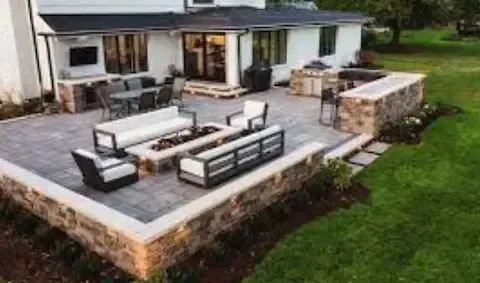
Permeable Paver Patios Suffolk VA High Water Tables
Suffolk, Virginia sits on some of the most hydrologically complex ground in the Hampton Roads region. Between the Nansemond River watershed, low-elevation neighborhoods that flood seasonally, and clay-heavy soils that hold water long after a storm passes, a standard compacted-gravel-and-sand paver base can become a swamp underneath your feet within a few years. If you've noticed standing water in your yard, soggy turf that never quite dries out, or downspouts that send water running across your property with nowhere to go, a permeable paver patio may be the most practical hardscape decision you can make for your home.
What Makes Suffolk's Water Table a Real Engineering Challenge
Suffolk's topography includes large flat areas with minimal natural slope, and the underlying soil profile typically transitions from sandy loam near the surface into dense clay or even hydric soils at relatively shallow depths. The practical result is that water has limited ability to percolate downward naturally. Seasonal groundwater levels in many Suffolk neighborhoods—particularly those west of Route 58 near Lake Cohoon or north of downtown toward Driver—can sit within 18 to 24 inches of the finished grade for weeks at a time.
A traditional impermeable patio in these conditions doesn't just collect surface water. It also interrupts whatever minimal natural infiltration was occurring across that footprint. During heavy rain events, the patio becomes a sheet-flow generator, pushing water toward your foundation, your neighbor's property, or low spots in your lawn. A properly engineered permeable paver system addresses both problems simultaneously: it handles surface runoff and maintains a pathway for water to continue moving through the base layers rather than pooling.
How Permeable Paver Systems Are Designed for High Water Table Conditions
The key distinction between a standard paver installation and a permeable one is the base system. A conventional patio base is compacted to create a stable, nearly impermeable platform. A permeable system is designed with open-graded aggregate layers that hold water temporarily and release it slowly. In areas with high water tables, the engineering has to account for situations where the ground beneath the base is already saturated.
In Suffolk's conditions, a well-designed permeable patio base typically includes these components from the bottom up:
- A geotextile separation fabric laid at subgrade to prevent fine soil particles from migrating upward into the drainage layers over time
- A deep-set open-graded stone reservoir layer, often 8 to 12 inches of clean angular VDOT No. 57 or No. 2 stone, which holds storm water volume and allows slow lateral movement and downward percolation when the water table drops
- A choker course of smaller clean aggregate, typically VDOT No. 8 stone, that bridges the gap between the reservoir and the bedding layer without migrating downward
- A bedding layer of chip aggregate or permeable jointing sand that supports the pavers while maintaining open voids
- Permeable joint material between pavers, either chip aggregate or permeable polymeric jointing sand, that allows water to enter the system from the surface
In cases where the water table is exceptionally high or seasonal flooding is a recurring problem, a perforated drain pipe can be embedded within the reservoir layer and routed to daylight at a distant low point or to a dry well. This gives the system an active outlet rather than relying entirely on passive percolation.
Paver Material Choices That Work in Suffolk's Climate
Not all pavers are suitable for permeable applications. The joint width, surface texture, and material density all affect how well the system performs over time. For Suffolk properties, the most practical material options fall into three categories.
Concrete permeable pavers are manufactured specifically for open-joint installations. Brands like Belgard's Aqua-Loc or Unilock's Eco-Optiloc include molded spacer nubs that maintain consistent joint width automatically. These are the most cost-effective permeable option and hold up well to freeze-thaw cycles, which are a factor even in coastal Virginia's mild winters.
Tumbled or hand-laid clay brick pavers installed on a permeable base with wider sand or chip-filled joints are a traditional alternative. They perform well aesthetically in Suffolk's older residential neighborhoods and offer a different visual character than contemporary concrete products. The trade-off is that joint maintenance becomes more important over time because clay brick absorbs less water through the face, so the joints carry all of the infiltration load.
Natural stone pavers—particularly irregular flagstone or cut bluestone—can be used in low-traffic residential settings with permeable base systems, though very large-format pieces require careful bedding to prevent rocking and joint failure. For Hardscaping projects in Suffolk that prioritize aesthetics, natural stone over a properly engineered permeable base is a viable premium option.
Installation Mistakes That Undermine Performance in High Water Table Areas
The most common failure mode for permeable patios in Suffolk isn't the paver material itself—it's compromises made during base installation. Several patterns appear repeatedly in failed systems.
Using standard bank run gravel or crushed concrete with fines in the reservoir layer is a critical error. Aggregate with fine particles compacts over time and loses its void space, turning the drainage layer into a water trap rather than a water holder. Only clean, washed, open-graded stone maintains adequate permeability through years of use.
Skipping the geotextile separation layer to cut cost is another common shortcut that causes long-term problems. Without it, the clay subsoil in Suffolk's typical site conditions migrates upward into the aggregate under hydrostatic pressure. Within a few years the bottom of the reservoir layer is clogged with fine material and infiltration rates drop dramatically.
Improper edge restraints are also an issue. Permeable bases, by design, are not compacted as aggressively as traditional bases. Without rigid edge restraints properly staked at grade, the perimeter pavers migrate outward over time and joints open unevenly, creating trip hazards and allowing vegetation to establish in the joints.
Maintenance Expectations for Suffolk Homeowners
A permeable patio installed correctly requires modest but consistent maintenance to preserve its performance. The biggest threat to long-term function is sediment loading—fine particles from wind, mulch beds, or nearby disturbed soil that settle into the joints and reduce infiltration capacity over years. In Suffolk's environment, where pine pollen, organic debris from nearby wetlands, and sandy topsoil are all present, joint maintenance is a real consideration.
Annual inspection of joint material and periodic extraction of accumulated sediment using a shop vacuum or low-pressure blower will extend system life significantly. Avoid using a pressure washer on permeable joints—the force drives fine particles deeper into the aggregate layers rather than removing them. For homeowners near the Nansemond River or in lower-lying sections of North Suffolk, checking that any perforated drain outlet remains clear and unobstructed after major storm events is also worth adding to the maintenance checklist.
Getting the Design Right Before Breaking Ground
Before specifying a permeable paver patio in Suffolk, it's worth conducting a simple soil infiltration test at the installation site. A basic percolation test—a hole filled with water and timed for drainage—tells you whether passive percolation is a realistic expectation or whether you need to plan for an active drainage outlet from the start. In sections of Suffolk with seasonally perched water, skipping this step and assuming infiltration will work leads to systems that back up regularly.
Site grading around the patio perimeter also matters. Even though water is meant to infiltrate through the paver surface, the surrounding grade should still direct surface flow away from the home's foundation. Permeable hardscape handles rainfall falling directly on the patio—it's not a collection point for the entire yard's runoff unless the system was specifically sized for that capacity.
If you're weighing costs alongside design decisions, reviewing our Suffolk hardscape pricing notes gives useful context for understanding where the budget goes in a permeable installation compared to a standard base. The difference is primarily in the volume and grade of aggregate required and in the labor to install a proper multi-layer drainage system rather than a single compacted base course. For Suffolk properties where water management is a persistent challenge, that investment in base engineering tends to pay for itself in avoided drainage problems and extended patio life.
